Selling in Chicago’s Gold Coast is not just about putting a sign out and hoping the right buyer strolls by. You’re competing with iconic views, landmark architecture, and discerning buyers who expect polish. If you want top results, your marketing must rise to the level of the neighborhood.
You may be weighing when to list, how much prep to do, and which marketing pieces actually move the needle. You’re not alone. The good news: there is a clear, proven playbook for standout marketing in the Gold Coast that fits both high‑rise condos and historic townhouses.
In this guide, you’ll learn which marketing investments deliver the best returns, how to tailor your approach by property type, what budgets and timelines look like, and how to compare agents based on verifiable proof. Let’s dive in.
Gold Coast market snapshot
Public data tells a consistent story when you read each figure in context. As of early 2026, Zillow’s value index places the typical Gold Coast home value around $392,343 and notes roughly a month to pending in that dataset. Redfin’s January 2026 read shows a median sale price near $499,000 with a longer median days on market. Realtor.com’s late‑2025 reporting places the median list price closer to $799,900. These metrics track different things (value index vs. closed sales vs. active list prices), so always note the date and metric type when you compare.
Your pricing decision should ultimately rely on a market‑accurate CMA pulled from MRED (the local MLS) and a close read of on‑building or on‑block comps. The Gold Coast’s mix of high‑rise condos and historic rowhouses means outliers can skew a single number fast.
At the higher end, luxury dynamics have been uneven. Some trophy properties still command eye‑level prices, while other downtown segments have seen pressure. Recent reporting has highlighted that mix, which raises the stakes on precise pricing and targeted marketing for luxury listings. See context in the Wall Street Journal’s coverage of Chicago’s top tier to understand why accuracy matters in this cycle: WSJ on uneven luxury performance.
What makes marketing “stand out”
Buyers shop with their eyes and their phones first. The right media package increases online views, improves saves, and attracts more qualified showings. Here are the core elements supported by industry research you should expect on a Gold Coast listing.
Staging that tells a story
- According to the National Association of REALTORS® 2025 Profile of Home Staging, 83% of buyers’ agents said staging made it easier for buyers to visualize the property as their future home. That is a direct path to faster, stronger offers. Read the findings in NAR’s report: NAR Profile of Home Staging.
- Large sample summaries compiled by the Real Estate Staging Association have shown many staged homes sell faster and, in numerous cases, above list in their dataset. See RESA’s consumer guide summary for directional stats: RESA staging statistics.
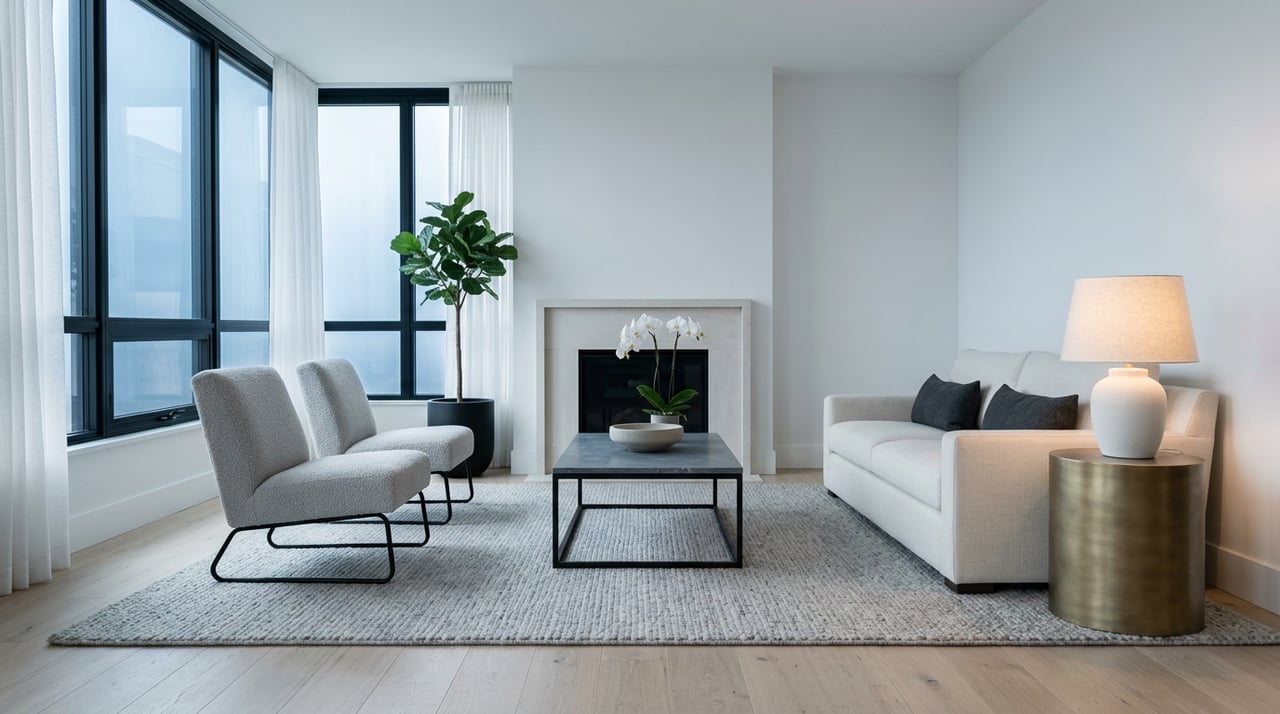
Practical tip: Aim for a light, neutral palette that lets lake light and skyline context shine in condos, and a curated mix that highlights woodwork and original detail in historic homes.
Photography that stops the scroll
Professional photography reliably correlates with more listing views and better outcomes in large brokerage research. A strong lead image, clean lines, and correct color balance matter. For urban listings, a twilight exterior or a blue‑hour skyline shot often serves as the hero image to boost early clicks.
3D tours and floor plans buyers rely on
Platform‑level analyses have shown that listings with 3D tours and accurate floor plans earn significantly more views and saves and often move to pending faster. In the Gold Coast, where out‑of‑area and international buyers are common, an interactive tour reduces wasted showings and increases qualified leads.
Video and aerials for emotional impact
Short walk‑through videos increase dwell time and help buyers connect to the flow. For marquee homes, a cinematic cut that weaves in building amenities, nearby streetscapes, or lakefront footage can be the difference between “interesting” and “must see.” Drone captures help showcase private terraces, rooftops, and lake proximity.
Tailoring by property type
Gold Coast marketing is not one‑size‑fits‑all. The neighborhood includes luxury towers, mid‑rise buildings, and historic homes within the Gold Coast Historic District. Shape your narrative to what buyers value in each segment.
Condos and high‑rise residences
- Lead with views, natural light, and the layout. Position the best sightline within the first few photos.
- Showcase building services and amenities with clarity: concierge or door staff, fitness and pool, parking options, storage, and assessments. Buyers want to understand daily life at a glance.
- Use amenity and neighborhood context shots that highlight Oak Street, the lakefront trail, and nearby dining and retail corridors.
- Include an accurate floor plan and a 3D tour to help non‑local buyers evaluate quickly.
Historic townhouses and rowhouses
- Headline architectural provenance. Note the year built, architect (if known), and significant restorations.
- Photograph period details up close: millwork, fireplaces, staircases, stained glass, and tile. Pair those with shots of updated kitchens and systems to show form and function.
- Emphasize private outdoor space and parking arrangements. In‑town convenience is a key value driver.
- Consider a short, tasteful historical note in the listing copy to elevate the home’s narrative.
Where great marketing gets seen
Distribution should match the quality of your media. MLS entry is the baseline, and from there your assets flow to major portals and buyer feeds.
- Start with MRED, Chicagoland’s MLS, which is the central data source for brokers and syndication. If you’re new to the acronym, see context on the MLS’s role here: MRED overview via GlobeNewswire.
- For luxury properties, push to high‑net‑worth channels through your brokerage network: Luxury Portfolio, Christie’s, Sotheby’s environments, Mansion Global, and select business press placements. Learn why these networks matter here: About Luxury Portfolio.
- Layer targeted digital amplification around launch: geo‑targeted and interest‑based ads, email campaigns to broker and buyer databases, and selective PR for trophy listings. A one‑week launch pulse is usually the most efficient spend.
Budgets that make sense
Costs vary by scope and property size, but you can plan within these common ranges in the Chicago market.
- Professional photography (interior/exterior): typically 175 to 550 dollars per listing; twilight or heavy retouching may add cost. See sample ranges: real estate photo pricing overview.
- 3D tour capture and hosting: often 100 to 800+ dollars depending on square footage and platform.
- Staging: consultations and partial staging often run 500 to 3,500 dollars; full vacant staging with furniture rentals can range from 2,000 to 6,000+ dollars, often billed monthly. A planning rule of thumb many pros use is about one percent of list price, but needs vary. See a consumer‑friendly cost guide: home staging cost guide.
- Video and aerials: 300 to 2,000+ dollars depending on production level; drone add‑ons often 150 to 400 dollars.
- Paid digital amplification: a focused launch pulse commonly starts around 200 to 1,000 dollars; you can scale for marquee properties.
Smart takeaway: invest first in the media that drives online engagement across every listing type — staging, professional photos, floor plans, and a 3D tour. Then scale video, drone, and paid distribution to match the property’s price point and uniqueness.
A clean, efficient listing timeline
Most Gold Coast listings can be launch‑ready within two weeks if you plan well.
- Pre‑listing prep: 3 to 14 days for repairs, deep cleaning, decluttering, and staging plans. Many agents recommend finishing prep before photos. See the staging profile for why the order matters: NAR Profile of Home Staging.
- Staging install: 1 to 7 days depending on scope and whether furniture rental is involved.
- Media capture and delivery: schedule photos, 3D, and drone the same day when possible; edited assets often arrive within 24 to 72 hours. See typical vendor SLAs: media pricing and timelines.
- MLS rules: if you publicly market a listing, Clear Cooperation rules affect how soon it must hit the MLS. Ask your agent to explain timing and syndication so your strategy stays compliant. For background: Clear Cooperation timing discussion.
What results to expect
Every property and cycle is different, but credible studies point in the same direction:
- Staging improves buyer visualization, and many agents report shorter time on market. NAR’s 2025 staging profile is a solid benchmark. Read NAR’s staging report.
- RESA’s aggregated samples have shown a meaningful share of staged homes selling above list, with strong ROI in many cases. Review RESA’s summary.
- Professional photography and 3D tours correlate with higher online engagement and generally faster sales in platform analyses.
In the current downtown luxury context, pairing premium presentation with price realism is essential. Local press has highlighted swift Gold Coast sales when listings are well presented and properly positioned. For example, recent coverage shows buyers acting early on standout properties in the neighborhood: two Gold Coast sales covered by The Real Deal.
Your agent comparison checklist
When you interview agents, ask for documentation you can verify before you sign a listing agreement.
- Show three recent Gold Coast listings you marketed with premium media. Request MLS numbers and before/after analytics: listing views, saves, days on market, and sale vs. list.
- What’s included vs. optional? Ask for a written, itemized marketing package: staging, twilight photography, 3D/Matterport, drone, video, paid ads, and luxury syndication. Request pricing for each line item to match your budget. Reference ranges like these: media pricing overview.
- Provide local proof that marketing moved the needle. Two Gold Coast closings where broker opens, luxury network placement, or PR coverage affected the outcome. Press clips help; see examples of neighborhood coverage like this: Gold Coast sales highlight.
- How will you reach out‑of‑area and international buyers? Get a specific plan for platform placements, email database outreach, and luxury networks such as Luxury Portfolio, Christie’s, or Sotheby’s. Learn about one such network: Luxury Portfolio overview.
- Clarify timeline and compliance. When will you go live, how will you handle Coming Soon vs. public marketing, and who pays for which marketing items? Confirm weekly reporting cadence after launch. For MLS timing context: Clear Cooperation timing discussion.
When your home presents like a magazine feature and reaches the right audience on day one, you stack the odds in your favor. If you are ready to put an elevated marketing plan to work for your Gold Coast condo or historic home, let’s talk about your goals and timeline.
Ready for a data‑driven pricing conversation and a custom launch plan? Connect with the Novit Soldit Group for a free valuation and a property‑specific marketing proposal.
FAQs
What does “standout marketing” mean for a Gold Coast condo?
- It means staged, professionally photographed spaces with a strong lead image, accurate floor plans, and a 3D tour, supported by targeted distribution through the MLS, luxury networks, and a focused launch ad pulse.
How much should I budget for staging in Chicago’s Gold Coast?
- Many projects fall between 500 and 3,500 dollars for consultations/partial staging, while vacant staging can be 2,000 to 6,000+ dollars; a common planning rule is roughly one percent of list price, adjusted to your needs.
How long does it take to prepare and launch my Gold Coast home?
- Most sellers can go live in about 7 to 14 days with a clear plan: 3 to 10 days for prep and staging, a day for media capture, 1 to 3 days for edits, then MLS submission and launch.
Do I really need a 3D tour and floor plan for a downtown listing?
- Yes, especially in the Gold Coast where out‑of‑area buyers are common; interactive tours and floor plans increase online engagement and help serious buyers qualify themselves before visiting.
How will my agent reach buyers who are not in Chicago?
- Your plan should include luxury network syndication, high‑quality media that travels well online, targeted digital ads by geography and interests, and direct outreach to broker and buyer databases.
How do you price my home when public numbers vary?
- Start with a CMA built from MRED comps, then use portal figures as context only; always compare apples to apples by property type, building, and line, and note the date and definition of each metric.
Do historic Gold Coast homes need a different marketing approach?
- Yes; highlight provenance and period detail with dedicated close‑ups, pair them with system upgrades and livability features, and include a concise historical note to elevate the narrative while keeping copy factual and neutral.